Hi! Have any doubts about studying abroad? Feel free to ask!
Inphase Assistant
Online
Hello! Welcome to Inphase Global. How can I help you today?
Learn from native-level instructors and gain the language skills needed for German university admission and integration.
Learn from certified C2-level German instructors with extensive experience in preparing students for university language exams.
Structured curriculum aligned with Goethe-Institut and TestDaF exam patterns to ensure you pass on your first attempt.
Small batch sizes focused on conversational practice, grammar, and listening comprehension to build real-world fluency.
Beyond language, we teach German culture, etiquette, and workplace norms to help you adapt smoothly upon arrival.
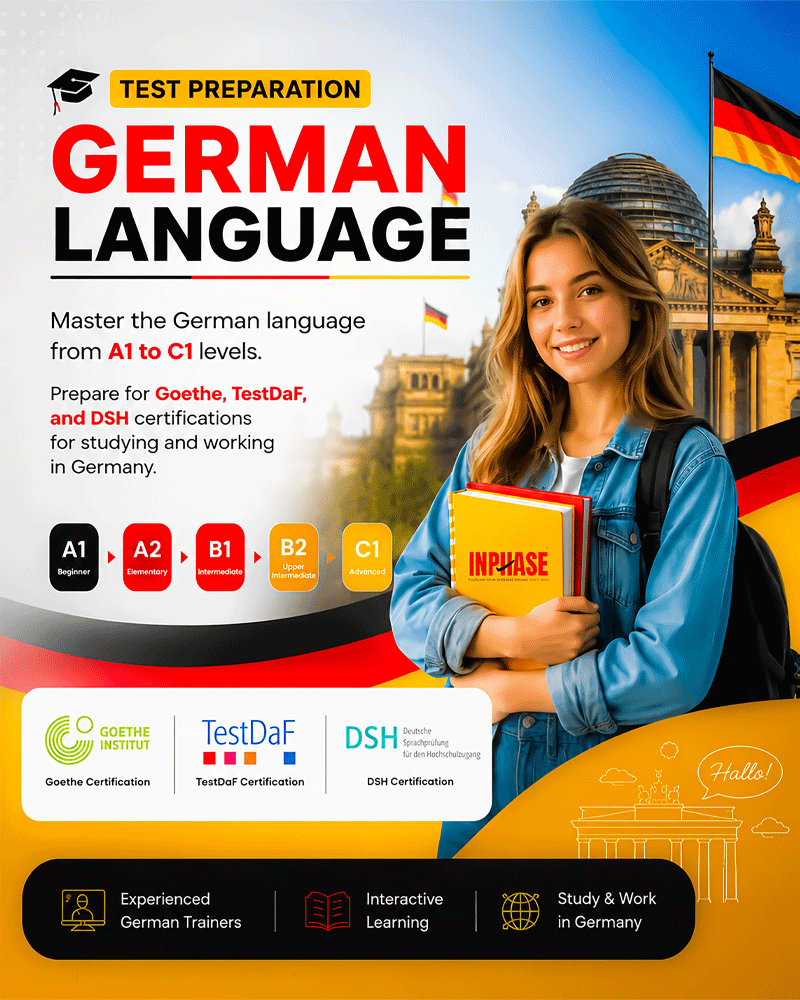
Depending on your goal—university admission, work, or permanent residence—different certifications are required.
The most widely recognized German language certification. Required for spouse visas and general proficiency. Conducted by the Goethe-Institut.
Test of German as a Foreign Language. Specifically designed for international students applying to German universities. Can be taken from your home country.
Deutsche Sprachprüfung für den Hochschulzugang. Conducted by individual German universities. Often taken after arriving in Germany.
Recognized for vocational training, nursing professions, and permanent residency applications in Germany.
German proficiency is graded across six levels under the CEFR, defining what a learner can do in reading, listening, speaking, and writing.
Can understand virtually everything and express spontaneously. Required for admissions to English-taught Master's programs or high-level professional roles.
Can understand the main points of clear standard input. B1 is required for permanent residency, B2 for most German-taught university courses.
Can understand and use familiar everyday expressions. A1 is required for spouse visas and is the starting point for learning the language.
Yes, and If your band Score increases, your re-evaluation fee will be refunded.
Not necessarily. There are numerous Master's and some Bachelor's programs taught entirely in English. However, learning German (at least A2/B1) is highly recommended for daily life, internships, and improving your post-study job prospects.
TestDaF is a standardized test that can be taken in your home country and is accepted by all German universities. DSH is conducted by individual universities in Germany, usually just before your course starts. Both assess B2-C1 level proficiency.
On average, it takes about 3 to 6 months of intensive study (approx. 150-200 hours of instruction) to reach B1 level from scratch, depending on your learning pace and native language.
Yes, Goethe-Zertifikat certificates (A1 to C2) are valid for a lifetime. However, some universities or employers may prefer a certificate that is no older than 2-3 years to ensure your current proficiency.